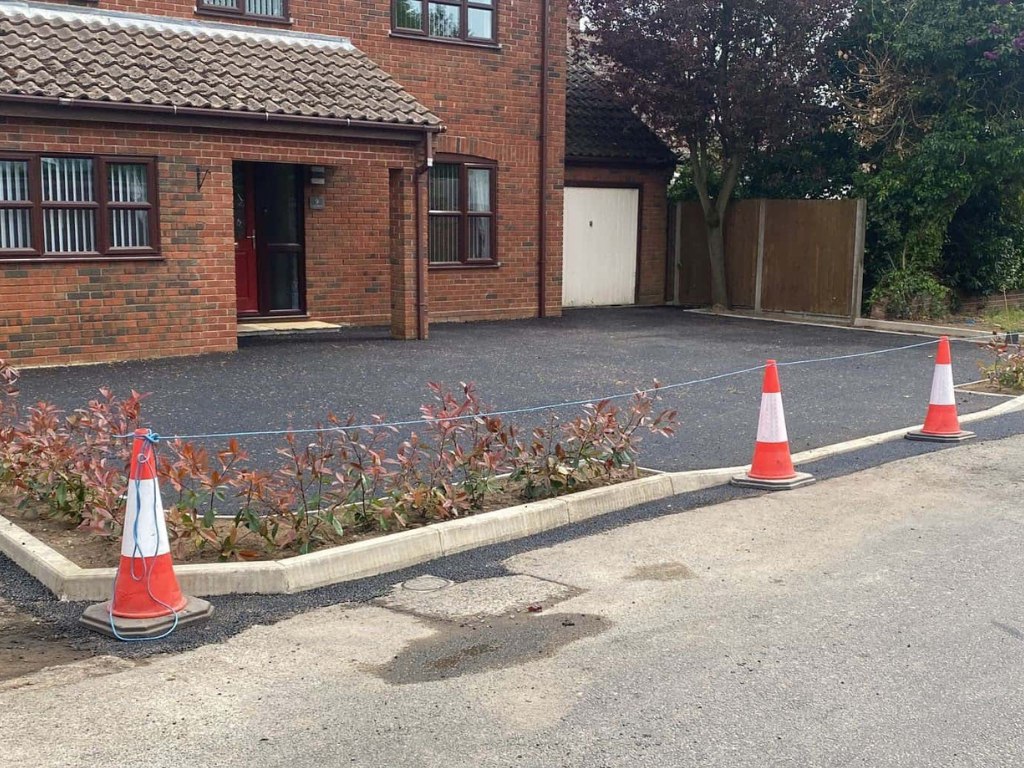
Why Is Tar & Chip a Practical Surface for Agricultural and Farm Roads?
Agricultural and farm roads need to perform a very different role from purely decorative residential surfaces. They may provide regular access for tractors, trailers, utility vehicles and other traffic while also being exposed to mud, rainfall and changing ground conditions. A practical surface therefore needs to be considered as part of a complete road construction rather than chosen solely for its finished appearance.
Tar & chip surfacing can be particularly well suited to these types of access routes. The process involves applying a bituminous binder followed by aggregate, creating a textured, hard-wearing surface over a properly prepared supporting base. It can be used to improve established tracks and access roads where the underlying construction is suitable.
For agricultural properties in Chertsey, Surrey, the effectiveness of a tar & chip road depends heavily on preparation. Drainage, grading, base stability, compaction, road width and expected traffic all need to be considered before surfacing begins. When these elements are properly addressed, tar & chip can provide a straightforward and practical finish for working access routes.
What Makes Tar & Chip Suitable for Agricultural and Farm Access Roads?
The practicality of tar & chip comes from the combination of its textured surface and relatively straightforward construction over a suitable base.
Important characteristics include:
- A robust surface for regular access
- A textured aggregate finish
- Suitability for long access roads
- Practical application over properly prepared bases
- Good integration with rural surroundings
- Suitability for straight and winding routes
- Defined access during wetter conditions
- Reduced loose material compared with an untreated track
- The ability to surface substantial areas consistently
- A functional appearance suited to working environments
However, the surface layer cannot compensate for poor foundations. The supporting road construction remains fundamental.
Agricultural Roads Need to Be Designed Around Their Actual Use
A farm access road should not be designed in exactly the same way as a lightly used garden path.
The vehicles travelling across it may be heavier, wider and used more frequently. Turning movements can also place additional demands on particular sections.
Before surfacing is considered, it is important to understand how the road will actually be used.
This includes identifying entrances, regular vehicle routes, turning areas and locations where traffic may repeatedly stop or change direction.
The Supporting Base Is Fundamental
Tar & chip provides the finished surface, but the strength and stability of the road depend heavily on what lies underneath.
An unstable base can move, settle or develop depressions regardless of the quality of the surface installed above it.
Preparation therefore needs to create a suitable platform for the expected use.
Where an existing agricultural road has deteriorated, the condition of its supporting construction should be assessed before deciding whether straightforward resurfacing is appropriate.
Tar & Chip Cannot Correct Major Base Failure
A deteriorated farm track may contain potholes, soft sections, ruts or areas that repeatedly become uneven.
Simply applying a new surface over these defects does not necessarily address their cause.
If the supporting material is unstable, the same movement can eventually influence the new surface.
Proper preparation may involve correcting weak areas, restoring appropriate levels and compacting the base before tar & chip is applied.
Grading Can Be an Important Part of Preparation
Agricultural roads often become uneven after repeated vehicle movements and exposure to changing weather.
High and low areas can develop, while wheel routes may gradually become more pronounced.
Grading helps establish appropriate levels before the final surface is installed.
The objective is not simply to make the road look flatter. Correct levels also influence how vehicles travel across it and how surface water moves away.
Compaction Helps Create Consistent Support
A road base needs to provide consistent support across its width and length.
Poorly compacted areas can behave differently from surrounding sections under repeated traffic.
Over time, this can contribute to depressions or unevenness.
Appropriate compaction during preparation helps create a more stable platform for the tar & chip surface and is particularly important where new material has been introduced to correct existing defects.
Drainage Is Essential on Farm Roads
Water is one of the most important factors to consider when constructing or improving an agricultural access road.
A durable surface alone cannot compensate for poor water management.
If rainfall consistently collects in low areas or remains around the road edges, the supporting construction can be affected over time.
Road levels, falls and surrounding ground should therefore be considered together so that water can move away appropriately.
Standing Water Can Reveal Problems With Road Levels
Puddles appearing repeatedly in the same locations can provide useful information about the shape of an existing road.
They may indicate depressions or areas where the surface no longer directs water effectively.
Before resurfacing, these locations should be investigated.
Installing tar & chip without correcting unsuitable levels can preserve the underlying shape rather than resolving it.
Edge Drainage Deserves Particular Attention
Water does not only affect the middle of an agricultural road.
The edges can become problematic where surrounding ground directs rainfall towards the surfaced area or prevents water from escaping.
Softening along the margins can gradually affect the effective road width.
Good preparation therefore considers how the road relates to adjoining ground rather than focusing exclusively on the area receiving the tar & chip finish.
Tar & Chip Provides a Textured Aggregate Surface
The exposed aggregate used in tar & chip creates a naturally textured finish.
This is one reason the material can work effectively for functional access roads.
The surface has a different character from a smooth decorative finish and is well suited to practical environments where appearance needs to work alongside everyday use.
The aggregate should be applied consistently so that the completed road has an even, coherent finish.
It Can Create a More Defined Route Than an Untreated Track
An untreated farm track can gradually lose definition.
Vehicle movements may create several informal wheel routes, while loose material can spread towards the sides.
A properly constructed tar & chip road creates a clearer, established access route.
This can make movement around the property more organised while reducing some of the problems associated with repeatedly driving over an unbound surface.
Loose Stone Movement Can Be Reduced
Loose aggregate tracks naturally experience movement as vehicles travel across them.
Material can be pushed towards the sides, displaced from wheel routes or collected into uneven areas.
Tar & chip works differently because the aggregate is incorporated into the bituminous surface treatment.
Some loose material may initially remain as part of the surfacing process, but the completed road is fundamentally different from a purely loose gravel track.
Long Access Roads Can Suit Tar & Chip Well
Agricultural properties can contain substantial lengths of access road.
Tar & chip can provide a practical way to create a consistent surface across these routes where the underlying base is appropriate.
Long roads particularly benefit from careful preparation.
Small inconsistencies in levels or drainage can become more significant when repeated over a substantial distance, making initial assessment and grading important.
Winding Farm Roads Can Also Be Surfaced
Not every agricultural access route follows a perfectly straight line.
Roads may curve around existing features or follow the practical layout of the land.
Tar & chip can accommodate these routes when the base and edges are properly prepared.
The road should still be designed around vehicle movement, particularly where larger vehicles need sufficient width to negotiate bends comfortably.
Road Width Should Reflect Vehicle Use
An agricultural road should provide sufficient usable width for the vehicles expected to travel along it.
A route that is unnecessarily narrow can concentrate traffic close to the edges.
This can become particularly relevant for larger vehicles.
Planning the road width around actual use helps keep normal wheel movements within the properly constructed area rather than repeatedly loading unsupported margins.
Entrances Often Receive Concentrated Traffic
The entrance to an agricultural access road may experience considerably more turning and manoeuvring than the main straight sections.
Vehicles can brake, accelerate and change direction within a relatively small area.
These movements should be considered during preparation.
A surface designed without accounting for concentrated entrance use may perform differently in this location from the quieter sections further along the road.
Turning Areas Need Appropriate Foundations
Farm vehicles may require substantial space to turn or reposition.
These areas can receive repeated loading from different directions.
The supporting construction therefore needs to reflect the intended use.
Tar & chip can provide a consistent finish across turning areas where the underlying base is suitable, but the surface should not be expected to provide structural strength that the foundation itself lacks.
Repeated Wheel Routes Can Reveal Weaknesses
Agricultural traffic often follows the same path day after day.
If the base contains weak sections, repeated loading can make them increasingly visible.
Ruts or depressions developing beneath common wheel routes can indicate that the issue extends below the surface.
These areas should be addressed during preparation rather than simply covered.
Potholes Need More Than Surface Covering
Potholes are an obvious sign of road deterioration.
Filling or surfacing over the visible depression without understanding the condition beneath can leave the underlying weakness unresolved.
The affected area may require appropriate preparation so that the repair integrates with stable surrounding material.
Once a suitable base has been restored, tar & chip can provide the finished surface across the repaired road.
Existing Farm Roads Should Be Assessed Before Resurfacing
An existing access road may already contain a substantial supporting base.
If that construction remains stable, it may provide a suitable starting point for improvement.
However, the road should not be assumed to be ready for tar & chip simply because vehicles can currently travel over it.
Ruts, drainage problems, edge deterioration and soft sections can all influence the preparation required.
Localised Weakness Does Not Always Mean Complete Reconstruction
A long agricultural road can remain generally stable while containing several weaker areas.
Where deterioration is genuinely localised, targeted preparation may be possible before the road receives its new surface.
The objective is to distinguish isolated defects from widespread base failure.
This assessment-led approach avoids unnecessarily disturbing sound sections while ensuring genuine weaknesses are not simply hidden beneath the finished surface.
Widespread Movement Requires a Broader Approach
If ruts, settlement and instability occur throughout much of the road, the problem may not be limited to a few isolated areas.
In this situation, more extensive preparation can become necessary.
Applying tar & chip directly over widespread instability would not correct the supporting construction.
The scope of the work should therefore reflect the actual condition of the road rather than concentrating only on its current surface appearance.
Agricultural Roads Need Strong Edges
The sides of a road can be vulnerable where vehicles regularly travel close to the boundary.
If the supporting construction becomes weaker towards the edges, repeated loading can contribute to deterioration.
Appropriate road width and edge preparation help provide a more consistent platform.
Keeping normal vehicle movements within the properly constructed surface can also reduce unnecessary loading of adjacent soft ground.
Muddy Edges Can Affect Everyday Access
Where the road surface meets soft surrounding ground, rainfall and vehicle movement can create muddy margins.
If vehicles frequently move off the prepared road, material can be carried back onto the surface.
Planning adequate width and maintaining clear road boundaries can help reduce this issue.
The surrounding ground and drainage should also be considered rather than treating mud purely as a surface-cleaning problem.
Tar & Chip Can Provide a Natural-Looking Finish
Agricultural access routes generally benefit from surfaces that fit comfortably within their surroundings.
The exposed aggregate finish of tar & chip creates a practical appearance that can work naturally within this type of environment.
Aggregate selection can influence the finished character.
However, practical considerations such as base condition, traffic and drainage should remain the priority when specifying the road.
Function Should Come Before Appearance
A farm road can look neat immediately after surfacing but still perform poorly if the preparation underneath is inadequate.
For this reason, the visible finish should never be the only consideration.
A well-constructed agricultural road begins with understanding the ground and intended traffic.
Once those requirements have been addressed, the tar & chip finish completes the surface rather than attempting to compensate for deficiencies underneath.
Regular Traffic Patterns Should Influence Construction
Different parts of an agricultural road may receive very different levels of use.
The main access route may experience frequent vehicle movements, while a secondary section is used only occasionally.
Understanding these patterns can help ensure preparation is appropriate for the demands placed on each area.
The same principle applies to entrances, junctions and turning points where concentrated movements occur.
Changes in Ground Conditions Can Affect Long Roads
The supporting ground beneath a long farm road may not be identical from one end to the other.
Some sections can remain firm while others are more susceptible to movement or retaining moisture.
This variation should be recognised during preparation.
Treating the complete road as though every section has identical ground conditions can overlook local weaknesses that may influence the finished surface later.
Surface Water Should Not Be Allowed to Dictate the Vehicle Route
Where an untreated track contains substantial puddles or muddy areas, drivers often begin moving around them.
This can gradually widen the travelled route and create additional disturbance at the edges.
A properly planned surfaced road with appropriate levels provides a more clearly defined route.
Good drainage remains essential, because the aim is to manage the cause of repeated water accumulation rather than simply provide a new surface around it.
A Consistent Surface Can Improve Everyday Access
Agricultural roads are working surfaces.
Their value comes from allowing routine movement around the property without requiring drivers to continually avoid potholes, deep loose material or heavily rutted sections.
A correctly prepared tar & chip road can create a more consistent route.
This practical improvement is often more important than achieving a highly decorative finish.
Tar & Chip Can Be Suitable for Connecting Different Working Areas
A farm road may connect an entrance with buildings, storage areas, yards or other regularly accessed parts of the property.
Using a consistent surface can make these routes feel more established and organised.
The construction can still vary where different areas experience different loading.
The important point is that each section is prepared according to how it will actually be used.
Surface Transitions Need Careful Planning
An agricultural road may meet other surfaced areas at various points.
These junctions need appropriate levels and preparation.
An abrupt or poorly supported transition can create a weak point where materials meet.
Planning these areas as part of the complete road construction helps produce a more coherent route rather than treating each surface independently.
Maintenance Starts With Keeping the Road Observable
Agricultural surfaces naturally accumulate mud, debris and material carried by vehicles.
Keeping the road reasonably clear makes it easier to observe changes in its condition.
Small depressions, edge movement or local deterioration can then be identified before they become hidden beneath accumulated material.
Maintenance should focus on understanding developing defects rather than simply keeping the surface visually tidy.
Early Attention to Local Defects Can Help Protect the Wider Surface
A small area of deterioration does not automatically mean the complete road is failing.
However, investigating local problems early can prevent them from being repeatedly subjected to traffic without attention.
Where the cause is limited to one section, focused repair may be appropriate.
This helps retain sound surrounding areas while restoring the affected part of the road.
Why Professional Tar & Chip Installation Matters
The success of an agricultural tar & chip road depends on considerably more than the final application of binder and aggregate.
Road levels, base stability, compaction, drainage, width, edge support and expected vehicle movements all influence the construction required.
At NS Driveways Chertsey, we assess the existing surface and intended use before recommending an appropriate preparation and surfacing approach.
For agricultural properties in Chertsey, Surrey, this means the finished tar & chip surface can be supported by groundwork designed around the actual demands of the access route rather than relying on the surface layer alone.
Conclusion
Tar & chip can be a practical choice for agricultural and farm roads because it provides a robust, textured and clearly defined surface suitable for substantial access routes. It can work particularly well where an existing track needs a more consistent finish or where a new working route is being properly constructed.
Its performance depends heavily on preparation. A stable base, appropriate compaction, effective levels, considered drainage and sufficient road width all need to be addressed before the final surface is installed. Potholes, rutting and unstable sections should be investigated rather than simply covered, because tar & chip cannot compensate for significant weakness underneath.
If you are considering tar & chip surfacing for an agricultural or farm access road in Chertsey, Surrey, contact NS Driveways Chertsey. We can assess the route, its existing condition and intended use before recommending a suitable approach to preparation and surfacing.
Call us on: 01372 233 596
Click here to find out more about NS Driveways Chertsey
Click here to complete our contact form and see how we can help with your driveways needs.